
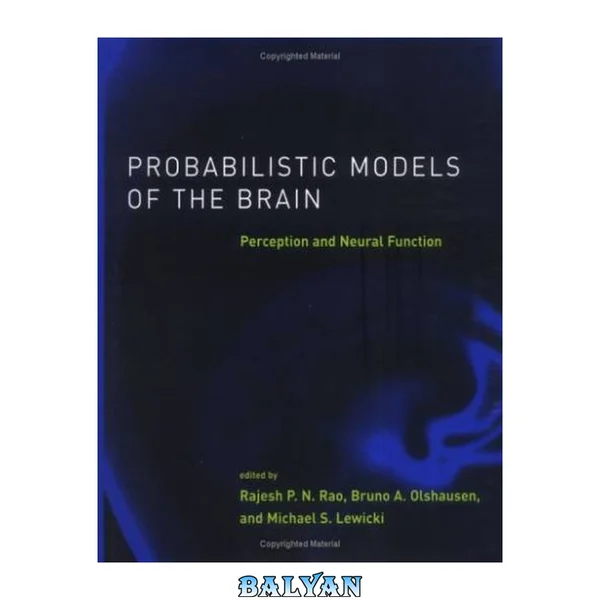
Probabilistic Models of the Brain: Perception and Neural Function (Neural Information Processing)
Rajesh P. N. Rao, Bruno A. Olshausen, Michael S. Lewicki (eds.)قیمت نهایی
- تخفیف زماندار−۵٬۰۰۰ تومان
۵٬۰۰۰ تومان صرفهجویی نسبت به قیمت اصلی
نسخه اصلی و اورجینال
بلافاصله پس از خرید، فایل کتاب روی دستگاه شما آمادهٔ دانلود است.
مشخصات کتاب
- ناشر
- A Bradford Book
- سال انتشار
- ۲۰۰۲
- فرمت
- زبان
- انگلیسی
- تعداد صفحات
- ۲۰ صفحه
- حجم فایل
- ۳٫۵ مگابایت
دربارهٔ کتاب
Neurophysiological, neuroanatomical, and brain imaging studies have helped to shed light on how the brain transforms raw sensory information into a form that is useful for goal-directed behavior. A fundamental question that is seldom addressed by these studies, however,is why the brain uses the types of representations it does and what evolutionary advantage, if any,these representations confer. It is difficult to address such questions directly via animal experiments. A promising alternative is to use probabilistic principles such as maximum likelihood and Bayesian inference to derive models of brain function.This book surveys some of the current probabilistic approaches to modeling and understanding brain function. Although most of the examples focus on vision, many of the models and techniques are applicable to other modalities as well. The book presents top-down computational models as well as bottom-up neurally motivated models of brain function. The topics covered include Bayesian and information-theoretic models of perception,probabilistic theories of neural coding and spike timing, computational models of lateral and cortico-cortical feedback connections, and the development of receptive field properties from natural signals.
Neurophysiological, neuroanatomical, and brain imaging studies have helped to shed light on how the brain transforms raw sensory information into a form that is useful for goal-directed behavior. A fundamental question that is seldom addressed by these studies, however, is why the brain uses the types of representations it does and what evolutionary advantage, if any, these representations confer. It is difficult to address such questions directly via animal experiments. A promising alternative is to use probabilistic principles such as maximum likelihood and Bayesian inference to derive models of brain function. This book surveys some of the current probabilistic approaches to modeling and understanding brain function. Although most of the examples focus on vision, many of the models and techniques are applicable to other modalities as well. The book presents top-down computational models as well as bottom-up neurally motivated models of brain function. The topics covered include Bayesian and information-theoretic models of perception, probabilistic theories of neural coding and spike timing, computational models of lateral and cortico-cortical feedback connections, and the development of receptive field properties from natural signals. Each waking moment, our body's sensory receptors convey a vast amount of information about the surrounding environment to the brain.کتابهای مشابه

Probabilistic Models of the Brain: Perception and Neural Function (Neural Information Processing)
۴۹٬۰۰۰ تومان
مدلهای احتمالی مغز: ادراک و عملکرد عصبی (پردازش اطلاعات عصبی)
۴۹٬۰۰۰ تومان
Exploratory Analysis and Data Modeling in Functional Neuroimaging (Neural Information Processing)
۴۹٬۰۰۰ تومان
Exploratory Analysis and Data Modeling in Functional Neuroimaging (Neural Information Processing)
۴۹٬۰۰۰ تومان

Exploratory Analysis and Data Modeling in Functional Neuroimaging (Neural Information Processing)
۴۹٬۰۰۰ تومان
Exploratory Analysis and Data Modeling in Functional Neuroimaging (Neural Information Processing)
۴۹٬۰۰۰ تومان
An Introduction to Lifted Probabilistic Inference (Neural Information Processing series)
۴۹٬۰۰۰ تومان
An Introduction to Lifted Probabilistic Inference (Neural Information Processing series)
۴۹٬۰۰۰ تومان
An Introduction to Lifted Probabilistic Inference (Neural Information Processing series)
۴۹٬۰۰۰ تومان
Modeling brain function : the world of attractor neural networks
۴۹٬۰۰۰ تومان
Neural Networks and Brain Function
۴۹٬۰۰۰ تومان
Toward Brain-Computer Interfacing (Neural Information Processing series)
۴۹٬۰۰۰ تومان
قیمت نهایی
۴۴٬۰۰۰ تومان