
LINQ Unleashed: for C# (Unleashed)
Paul Kimmelقیمت نهایی
- تخفیف زماندار−۵٬۰۰۰ تومان
۵٬۰۰۰ تومان صرفهجویی نسبت به قیمت اصلی
نسخه اصلی و اورجینال
بلافاصله پس از خرید، فایل کتاب روی دستگاه شما آمادهٔ دانلود است.
مشخصات کتاب
- نویسنده
- Paul Kimmel
- ناشر
- Sams Publishing
- سال انتشار
- ۲۰۰۸
- فرمت
- زبان
- انگلیسی
- حجم فایل
- ۵٫۱ مگابایت
- شابک
- 9780672329838، 9780768685367، 9780768685381، 9781282649613، 9786612649615، 0672329832، 0768685362، 0768685389، 1282649612، 6612649615
دربارهٔ کتاب
Foreword by Darryl Hogan, Architect Evangelist, Microsoft Corporation
Microsoft’s highly anticipated LINQ query technology makes it easy to retrieve any information programmatically from any data source, no matter where it comes from or how it’s stored. Using LINQ, developers can query objects, relational databases,
This is a definitive guide to getting real-world results with LINQ, using C# 3.0 and Visual Studio 2008. In LINQ Unleashed, Microsoft MVP Paul Kimmel covers every facet of LINQ programming, showing how LINQ can help you dramatically improve your productivity and build more reliable, maintainable applications.
Kimmel begins by reviewing the state-of-the-art C# programming techniques LINQ uses, including anonymous types, partial methods, and Lambda expressions. Next, using realistic examples and easy-to-adapt sample code, he details the most powerful new LINQ techniques for accessing objects, databases, and
- Build efficient LINQ queries to .NET objects, SQL databases, and
Utilize anonymous types to reduce design time, coding effort, and debugging time
- Automatically generate .NET state machines with the new yield return construct
- Master LINQ query syntax, operators, extension methods, sorting, grouping, aggregate and set operations, and more
- Make the most of select—and use it in the business layer of your n-tier applications
- Query relational data stored in Microsoft SQL Server
- Use nullable types to eliminate unnecessary database access plumbing code
- Use LINQ with ADO.NET 3.0 and Microsoft’s powerful new Entity Framework
- Extract
Automatically construct
Query Active Directory by extendingLINQ
Introduction 1
Part I Getting Ready for LINQ
1 Programming with Anonymous Types 5
2 Using Compound Type Initialization 29
3 Defining Extension and Partial Methods 61
4 yield return: Using .NET’s State Machine Generator 85
5 Understanding Lambda Expressions and Closures 97
6 Using Standard Query Operators 121
Part II LINQ for Objects
7 Sorting and Grouping Queries 137
8 Using Aggregate Operations 151
9 Performing Set Operations 167
10 Mastering Select and SelectMany 185
11 Joining Query Results 211
12 Querying Outlook and Active Directory 239
Part III LINQ for Data
13 Querying Relational Data with LINQ 265
14 Creating Better Entities and Mapping Inheritance and Aggregation 289
15 Joining Database Tables with LINQ Queries 309
16 Updating Anonymous Relational Data 349
17 Introducing ADO.NET 3.0 and the Entity Framework 383
Part IV LINQ for
18 Extracting Data from
19 Comparing LINQ to
20 Constructing
21 Emitting
463
22 Combining
23 LINQ to XSD Supports Typed
Index
This is the eBook version of the printed book. If the print book includes a CD-ROM, this content is not included within the eBook version.Foreword by Darryl Hogan, Architect Evangelist, Microsoft Corporation Microsoft's highly anticipated LINQ query technology makes it easy to retrieve any information programmatically from any data source, no matter where it comes from or how it's stored. Using LINQ, developers can query objects, relational databases, XML documents, and ADO.NET datasets--and do it all directly from C# 3.0, leveraging the powerful capabilities of LINQ. This is a definitive guide to getting real-world results with LINQ, using C# 3.0 and Visual Studio 2008. In LINQ Unleashed, Microsoft MVP Paul Kimmel covers every facet of LINQ programming, showing how LINQ can help you dramatically improve your productivity and build more reliable, maintainable applications. Kimmel begins by reviewing the state-of-the-art C# programming techniques LINQ uses, including anonymous types, partial methods, and Lambda expressions. Next, using realistic examples and easy-to-adapt sample code, he details the most powerful new LINQ techniques for accessing objects, databases, and XML. You'll gain a deep and practical understanding of how LINQ works “under the hood”--and learn how to do everything from selecting data through integrating XML with other data models. Build efficient LINQ queries to.NET objects, SQL databases, and XML content Utilize anonymous types to reduce design time, coding effort, and debugging time Automatically generate.NET state machines with the new yield return construct Master LINQ query syntax, operators, extension methods, sorting, grouping, aggregate and set operations, and more Make the most of select--and use it in the business layer of your n-tier applications Query relational data stored in Microsoft SQL Server Use nullable types to eliminate unnecessary database access plumbing code Use LINQ with ADO.NET 3.0 and Microsoft's powerful new Entity Framework Extract XML data without the hassles or complexity of XPath Automatically construct XML from CSV files and other non-XML data Query Active Directory by extending LINQ Introduction 1 Part I Getting Ready for LINQ 1 Programming with Anonymous Types 5 2 Using Compound Type Initialization 29 3 Defining Extension and Partial Methods 61 4 yield return: Using.NET's State Machine Generator 85 5 Understanding Lambda Expressions and Closures 97 6 Using Standard Query Operators 121 Part II LINQ for Objects 7 Sorting and Grouping Queries 137 8 Using Aggregate Operations 151 9 Performing Set Operatio "This is a definitive guide to getting real-world results with LINQ, using C# 3.0 and Visual Studio 2008. In LINQ unleashed, Microsoft MVP Paul Kimmel covers every facet of LINQ programming, showing how LINQ can help you dramatically improve your productivity and build more reliable, maintainable applications." "Kimmel begins by reviewing the state-of-the-art C# programming techniques LINQ uses, including anonymous types, partial methods, and Lambda expressions. Next, using realistic examples and easy-to-adapt sample code, he details the most powerful new LINQ techniques for accessing objects, databases, and XML. You'll gain a deep and practical understanding of how LINQ works "under the hood" - and learn how to do everything from selecting data through integrating XML with other data models."--book jacket A thorough overview of LINQ (Language Integrated Query), the most important new feature in Visual Studio 2008, explains how to use LINQ to improve access for .NET developers, furnishes helpful explanations that demonstrate how to use LINQ in applications, and covers such topics as conversion operators, lambda expressions and closures, relational data, and much more. Original. (Intermediate)کتابهای مشابه

LINQ Unleashed: for C# (Unleashed)
۴۹٬۰۰۰ تومان
LINQ Unleashed: for C# (Unleashed)
۴۹٬۰۰۰ تومان
LINQ unleashed for C# Includes index
۴۹٬۰۰۰ تومان
LINQ for Visual C# 2008
۴۹٬۰۰۰ تومان
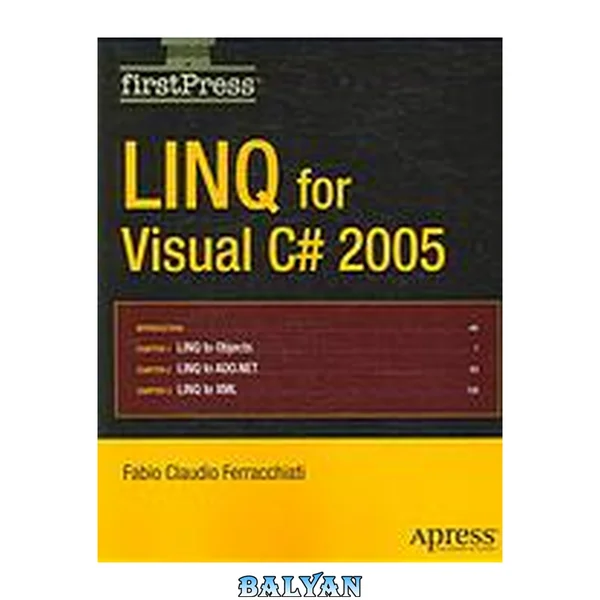
LINQ for Visual C# 2005 (FirstPress)
۴۹٬۰۰۰ تومان
LINQ for Visual C# 2008 (FirstPress)
۴۹٬۰۰۰ تومان
LINQ for Visual C# 2005 (FirstPress)
۴۹٬۰۰۰ تومان
LINQ for Visual C# 2005 (FirstPress)
۴۹٬۰۰۰ تومان
LINQ for Visual C# 2008 (FirstPress)
۴۹٬۰۰۰ تومان
LINQ for Visual C# 2005 (FirstPress)
۴۹٬۰۰۰ تومان
C# 4.0 Unleashed
۴۹٬۰۰۰ تومان
C# 4.0 Unleashed
۴۹٬۰۰۰ تومان
قیمت نهایی
۴۴٬۰۰۰ تومان